Claude Monet
Two Painters, One Household at Argenteuil
In the mid-1870s Renoir often travelled out to Argenteuil, on the Seine northwest of Paris, to paint alongside his friend Claude Monet, who had settled there with his family. The two artists worked within easy reach of one another’s easels.
They had known each other since their student days in the studio of Charles Gleyre, and by 1875 they were sometimes painting the same view of the river within feet of one another. The friendship had already lasted well over a decade.
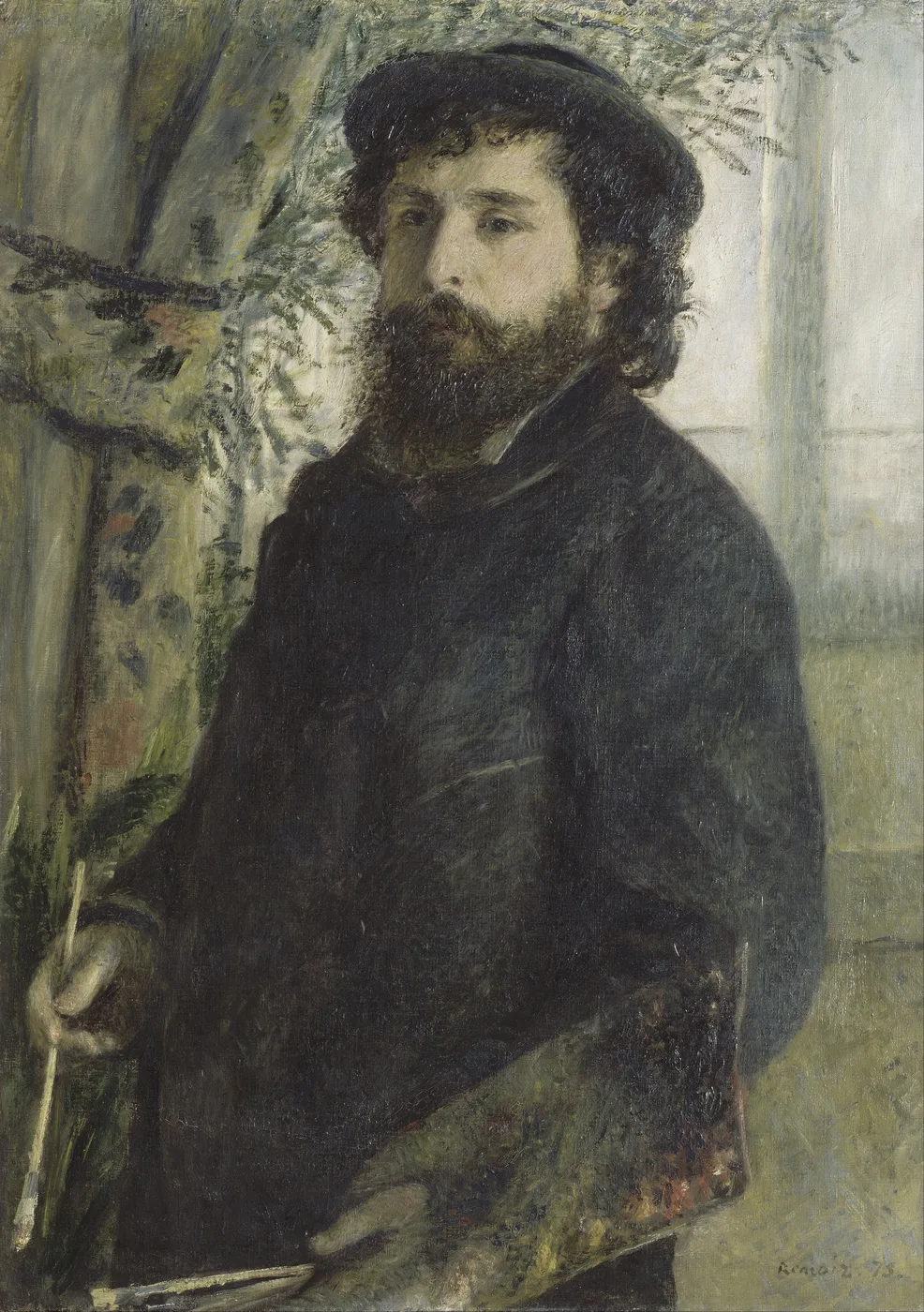
This portrait is Renoir’s painting of Monet himself, made during one of these visits. It shows the fellow painter, not a work by Monet, and it belongs entirely to Renoir’s hand and eye.
Renoir painted Monet more than once across these years, treating him as a familiar face rather than as a formal sitter. This particular canvas is one of the more informal results of that habit.
In 1869, several years before this portrait, Renoir and Monet had famously painted side by side at La Grenouillère, a bathing spot on the Seine, producing closely related canvases often cited as a founding moment of Impressionist technique. Their working partnership at Argenteuil in the mid-1870s continued that earlier collaboration.
A Friend Caught in Profile, Not a Commission
Renoir shows Monet’s head and shoulders, turned to one side, wearing a cap pulled down over his brow and a jacket buttoned against the weather. The pose feels unplanned rather than arranged.
There is nothing formal about it. Monet does not look out at the viewer; he appears caught mid thought, absorbed in something outside the frame, quite possibly his own painting.
This informality suits the relationship between the two men. Renoir was not working to satisfy a patron here; he was recording a friend he saw almost daily.
Quick Strokes for a Quick Likeness
The paint is applied rapidly, in short, visible strokes that leave the canvas texture showing through in places, particularly around the background. Little time seems to have been spent on any single passage.
Renoir does not linger over detail. Monet’s beard is suggested rather than drawn hair by hair, and the cap is built from a few confident passes of darker pigment rather than a carefully modelled object.
This speed gives the portrait an immediacy that a more finished likeness would lose. It reads as though Renoir set down his impression of Monet in the time it took his friend to glance away and back again.
Such rapid working suited both men’s habits at Argenteuil, where they were more used to chasing changing light outdoors than to sitting still for one another. Formal, lengthy sittings were rare between the two of them.
A Portrait by One Impressionist of Another
The colours are muted throughout, dominated by browns, greys and the darker cap, with warmer flesh tones reserved for the face itself. Nothing here competes with the sitter’s presence.
This restraint sets the portrait apart from the brighter, sun-filled landscapes the two men were painting at Argenteuil in these same years. It shows that Renoir could work in a quieter, more sombre register when the subject called for it.
Seen alongside the wider history of their friendship, the painting stands as a document of one of the closest working relationships in Impressionist painting. Few other pairs of artists shared their working methods so openly.
Monet was among the very few artists whose judgement Renoir trusted completely during these uncertain years for the wider Impressionist group. The two continued to correspond and exhibit alongside each other for decades afterward.
Living with Renoir’s Claude Monet
The portrait now hangs at the Musée d’Orsay in Paris, among a wider collection of Impressionist paintings that includes work by Monet himself. The two friends’ work now shares gallery walls, much as they once shared riverbanks.
In gallery light, the loose brushwork of the cap and jacket seems to vibrate slightly, while Monet’s face remains the calmest, most legible passage in the whole canvas. The contrast holds the eye longer than a more finished portrait might.
It is a small picture, easy to walk past, but it repays a pause. Two painters were testing the same new way of seeing, with one of them for once on the other side of the easel.
Sizes and materials for Claude Monet are listed on its product page.