A Girl with a Watering Can
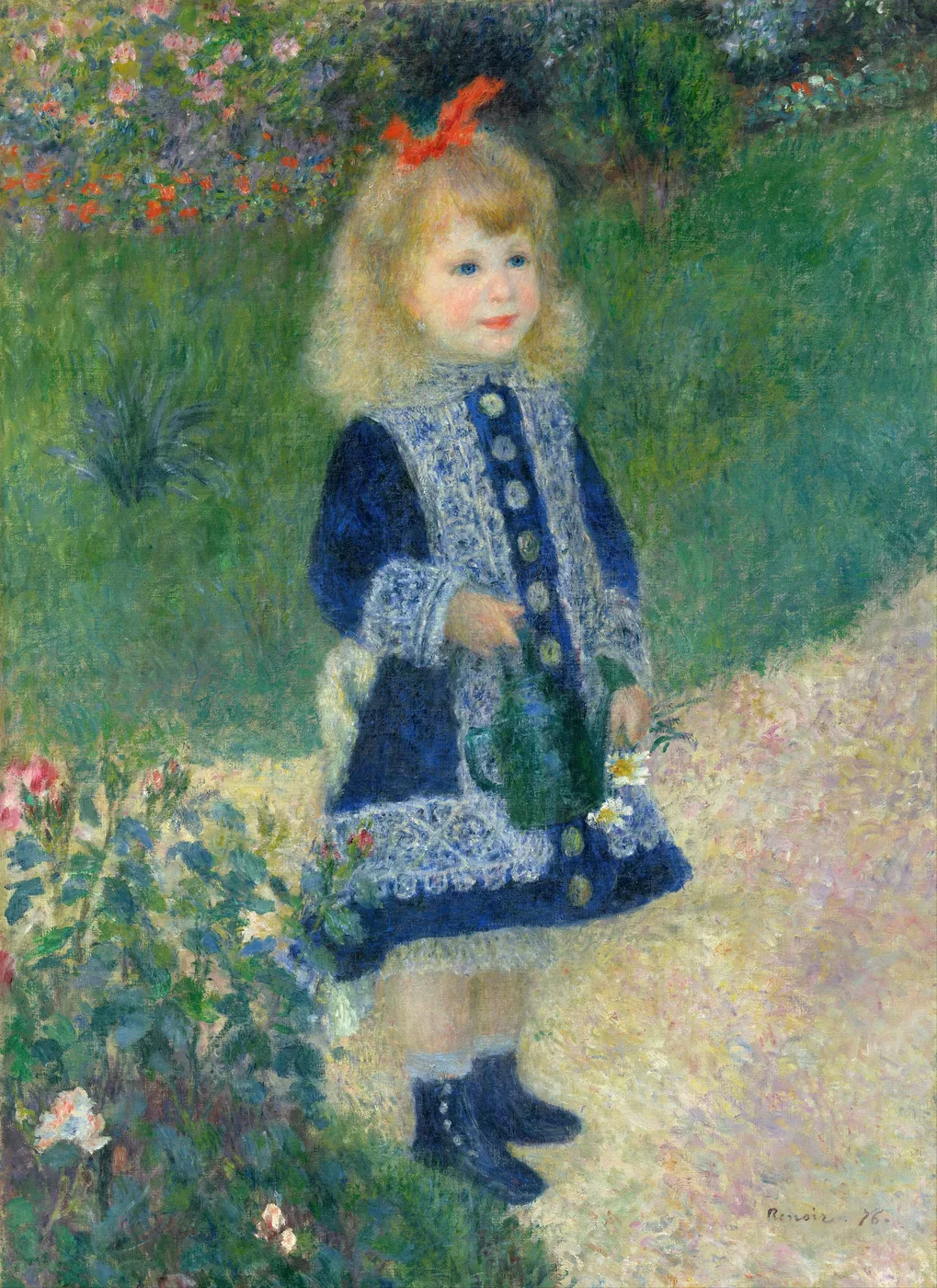
A Child’s Portrait Painted Outside the Studio
In 1876, Renoir was deep in the most concentrated Impressionist phase of his career, working alongside Monet on riverside and garden subjects and pushing himself to paint figures in real outdoor light rather than under the controlled conditions of a studio. A Girl with a Watering Can belongs to this period of garden pictures, small portraits of children and open-air figure studies.
The identity of the child has never been fixed with certainty; she appears to be a young girl, perhaps five or six years old, dressed for an outing rather than for play, standing on a gravel path bordered by flower beds.
Unlike Renoir’s more formal society commissions from the same decade, this is an intimate, almost anecdotal picture, the kind of subject he could paint quickly, working directly from a model in daylight rather than building up a portrait over many sittings.
Blue Dress, Green Can, Scattered Flowers
The girl stands close to the centre of the canvas in a blue dress gathered at the waist with a wide sash, her hands holding a small green watering can at her side. Loose curls of light brown hair frame her face beneath a fringe, and she looks out toward the viewer with the slightly solemn, self-conscious expression children often have when asked to stand still.
Around her feet, low flowering plants and scattered blossoms in pink, red and white break up the gravel path, echoing the pink of her sash and the touches of colour in her cheeks. The garden setting recedes behind her in loosely brushed greens, with no sharply defined trees or architecture to distract from the small figure at the centre.
The watering can itself, painted in cool green with a few bright highlights, is the picture’s one clearly modern prop, tying the portrait to a specific childhood activity rather than to any generalised idea of innocence or youth.
Sunlight Filtered Through a Garden
Renoir handles the outdoor light here with the same broken, flickering brushwork he was using in his larger garden and riverside scenes of the mid-1870s. Sunlight does not fall evenly across the picture; it catches the top of the girl’s head, the ridge of her sash and the rim of the watering can, while leaving other passages in softer, cooler shadow.
That dappled, uneven light is one of the clearest signs of Renoir working outdoors, or at least studying outdoor light closely, rather than composing an interior studio portrait with a single artificial source. The palette throughout stays light and high-keyed, built from blues, greens, pinks and creams rather than the darker tones he sometimes used for formal portraiture.
Shadows in the picture are never simply grey or black; they carry blue and violet tints, consistent with Renoir’s Impressionist habit of finding colour even in the darkest parts of a sunlit scene.
A Small Canvas With an Unusually Direct Gaze
Part of what has made this picture so well loved is the directness of the child’s gaze; she is not absorbed in play or looking away, but meets the viewer’s eyes with an expression that is neither posed smile nor blank stare. That small psychological detail gives an otherwise simple garden subject real presence.
Renoir avoids sentimentalising the child through exaggerated sweetness; her stance is a little stiff, her expression a little wary, and the overall effect reads as an observed moment rather than an idealised image of childhood.
Renoir painted several such single-child studies in this decade, but this one has become the best known, largely because of the immediacy of that gaze and the freshness of the garden setting around her.
The Painting at the National Gallery of Art
A Girl with a Watering Can hangs today in the National Gallery of Art in Washington, part of the substantial group of Impressionist paintings given to the museum by the collector Chester Dale, whose gifts did much to establish the gallery’s reputation for French nineteenth-century painting.
It remains one of the most reproduced of all Renoir’s works, in part because of its manageable scale and immediately legible subject, a single child in a garden, but the appeal holds up well beyond reproduction. In the gallery, the picture’s high-keyed colour and flickering light reward close looking, especially the passages around the girl’s feet where the flowers and gravel dissolve into pure, quick touches of paint.
Even a viewer who has seen the image many times in reproduction tends to notice, in front of the actual canvas, how much of its charm depends on paint handling rather than subject alone: the specific greens of the can, the exact pink of the sash, and the slightly uneven, sunlit surface of a garden path caught on a particular afternoon in the 1870s.
Sizes and materials for A Girl with a Watering Can are listed on its product page.