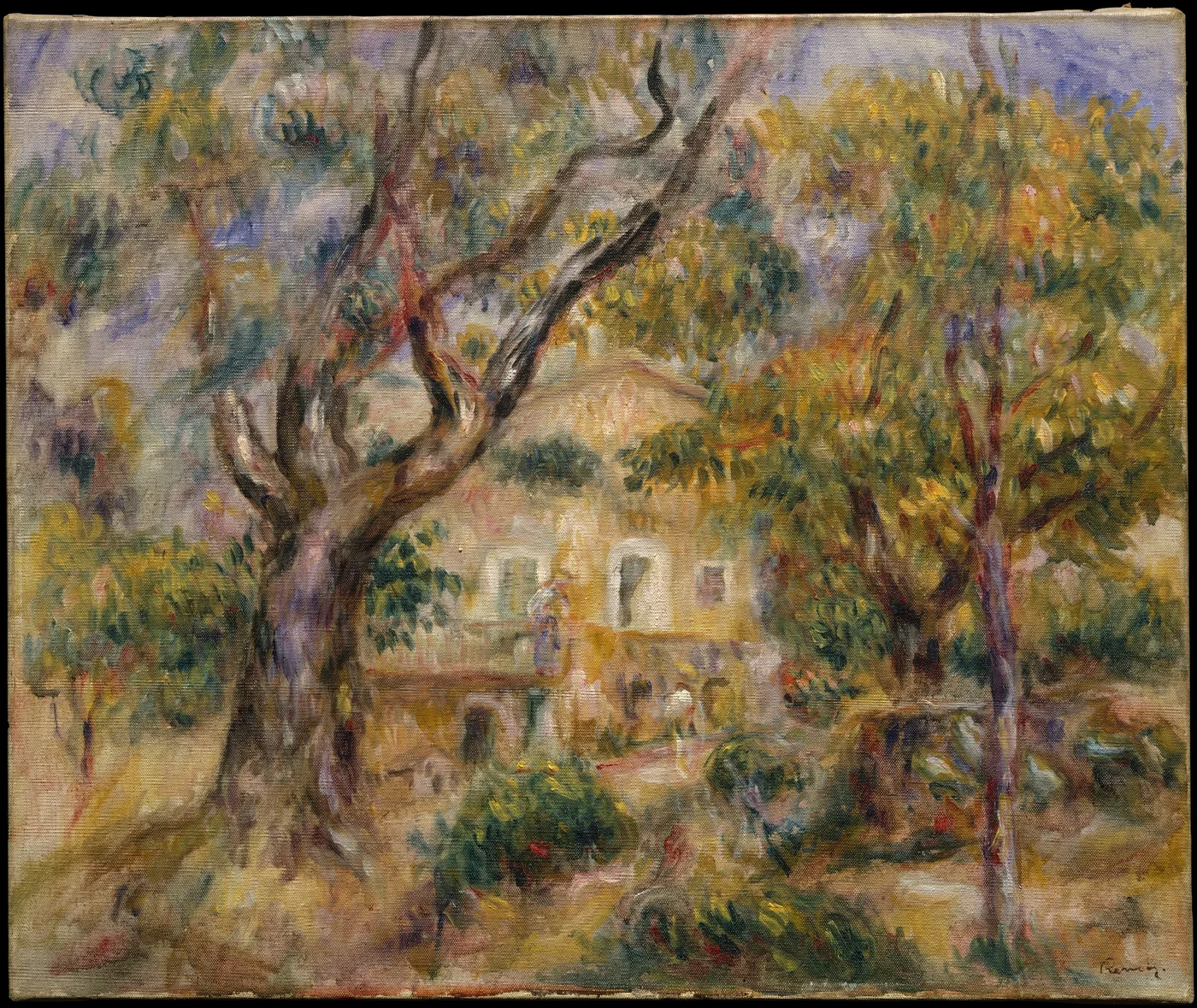
The Farm at Les Collettes, Cagnes
Les Collettes: A Farm Bought to Save Its Trees
In 1907 Renoir learned that the owner of a farm near Cagnes-sur-Mer, a property called Les Collettes, planned to cut down its ancient olive trees. Renoir, by then wealthy enough from decades of successful painting, bought the land largely to stop this from happening, and construction soon began on a house where he would spend the rest of his life.
Building the house took time, and Renoir continued working from a temporary studio nearby while it was completed. He was not a man inclined to let building work slow down his output.
By 1911, the date of this painting, Renoir and his family were settled at Les Collettes, and the farm itself, its old buildings, olive trees and surrounding garden, had become one of his most constant subjects. He no longer needed to travel far in search of motifs; everything he wanted to paint was within sight of his own studio window or garden path.
The move south had been driven largely by Renoir’s declining health. Rheumatoid arthritis had made the damp winters of Paris increasingly difficult to bear, and the warmer, drier climate of the Riviera eased his condition enough for him to keep working through his final decade.
Renoir’s Final Home in the South
Les Collettes gave Renoir something he had rarely had in Paris or the other towns he had lived in: a landscape he owned outright and could return to again and again across different seasons and hours of the day. The farm’s old stone buildings, its terraces and its silvery olive groves became subjects he painted repeatedly in his final years.
His son Jean, who would later become a celebrated filmmaker, spent formative years at Les Collettes. He later wrote vividly about his father’s life there, working in a wheelchair or with brushes strapped to his hands as arthritis worsened, yet still painting daily with evident pleasure.
Renoir himself, by his family’s own account, remained content at Les Collettes in these years despite his physical decline. He remained surrounded by his garden, his family and the models who continued to sit for him.
This painting captures the farm itself rather than a posed family scene, presenting the buildings and trees as Renoir actually encountered them. These were structures worn by generations of use, standing among trees far older than any of the people living among them.
Olive Groves and Ochre Walls: Reading the Canvas
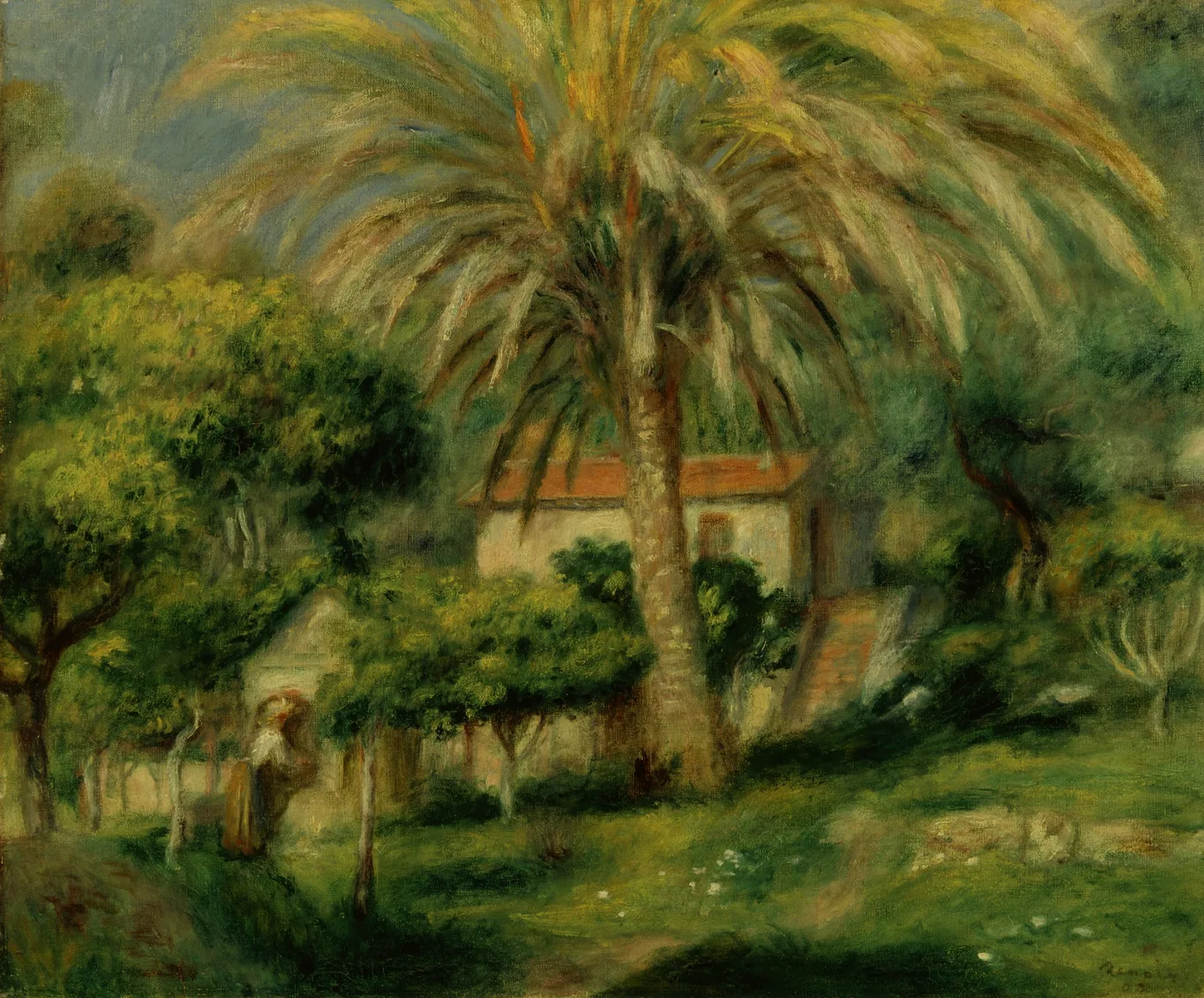
The picture shows the farm buildings of Les Collettes set among their surrounding olive trees, the architecture rendered in warm ochres and soft pinks that catch the Mediterranean light. The trees themselves, with their characteristically silvery, grey-green foliage, are painted in loose, feathery strokes that let dabs of sky and warm ground colour flicker through the branches.
Renoir’s brushwork throughout is dense and active, built from short, overlapping strokes rather than broad flat passages, giving the whole surface a quality of shimmer typical of his late landscape style. There is no single sharp focal point; instead the eye moves across the canvas, from warm walls to silvery leaves to patches of ground and sky, in the same unhurried way a visitor’s eye might wander across the actual farm.
Colour throughout is warm and harmonious rather than sharply contrasted, ochre and rose tones in the buildings sitting comfortably beside the cooler greens of the olive leaves and the pale blue suggestions of sky above. This is landscape painted from long, repeated familiarity rather than a single passing visit.
Compared with Renoir’s earlier Impressionist landscapes of the 1870s, the brushwork here is looser still and the forms softer. It is less concerned with recording a precise, fleeting moment of weather than with conveying the enduring warmth of a place Renoir had come to know intimately over several years.
A Late Landscape at the Metropolitan Museum
The Farm at Les Collettes, Cagnes now hangs at the Metropolitan Museum of Art in New York. It sits among a substantial holding of Impressionist and Post-Impressionist paintings that lets visitors trace Renoir’s development from his early Parisian street scenes through to these final, sun-soaked landscapes of the south.
Seen alongside earlier Renoir landscapes in the same museum, this picture shows how far his late style had travelled from the crisp, broken brushwork of the 1870s toward something warmer, looser and more concerned with atmosphere than incident. The change is unmistakable once the two periods are placed side by side.
The farm at Les Collettes still exists today, its house and garden preserved. The buildings and trees in this painting can, unusually for a Renoir subject, still be visited in something close to the form he painted them.
On a wall, the painting’s warm ochres and soft greens respond gently to the light in a room. They glow under afternoon sun much as the actual farm buildings would have done, and settle into quieter, cooler harmony in the evening, carrying something of the particular, sun-warmed calm Renoir found in his last years.
Sizes and materials for The Farm at Les Collettes, Cagnes are listed on its product page.