Portrait of Jeanna Samary
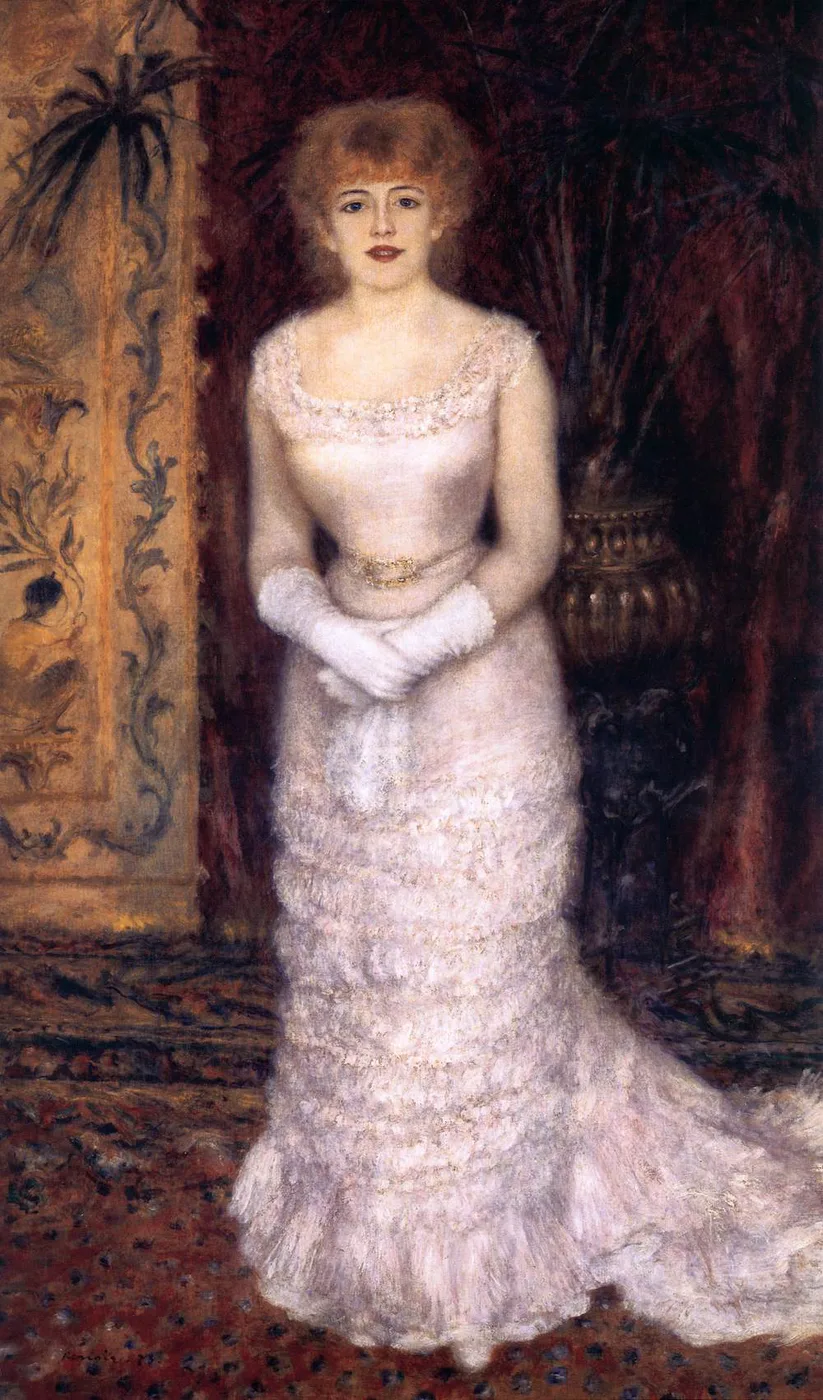
Jeanne Samary, the Comédie-Française’s Rising Star
In 1878 Jeanne Samary was in her early twenties and already a rising star of the Comédie-Française, admired for the warmth and wit she brought to comic roles on the Parisian stage. She belonged to the same circle of artists, writers and performers that Renoir moved through in these years, and the two became genuine friends rather than simply painter and paid sitter.
The Comédie-Française itself was one of the most prestigious stages in Paris, and a young actress who succeeded there moved in the same elevated cultural circles as painters, critics and writers of the day. That overlap between the art world and the theatre world was part of what brought Renoir and Samary together in the first place.
Renoir painted Samary several times across the late 1870s, drawn to a face that combined liveliness with an unusually luminous, fair complexion. This portrait, now in the Hermitage Museum in St Petersburg, is one product of that recurring interest.
Samary’s career would be cut short; she died in 1890, still only in her early thirties, after contracting typhoid fever. Renoir’s portraits of her from over a decade earlier remain among the clearest records of how her contemporaries saw her charm and vitality at the height of her fame.
Renoir and the Actress: A Friendship in Paint
By 1878 Renoir was still working to establish himself financially, taking portrait commissions from friends, patrons and, in Samary’s case, a sitter whose fame and personality made her an appealing subject in her own right. Painting an actress rather than a society lady gave Renoir a different kind of licence, since Samary’s public profile already invited an informality that a more conventional client might not have welcomed.
Samary was a well-known presence on the Parisian stage of the period, admired for her comic roles at the Comédie-Française. Renoir’s repeated returns to her as a subject in this period reflect that appeal as much as any formal artistic agenda.
The result is a portrait that feels closer to a study of personality than a formal record of status or wealth. Renoir was less concerned with signalling Samary’s profession through obvious props or a theatrical setting than with capturing something of her particular warmth directly through paint.
Colour and Likeness in the Hermitage Canvas
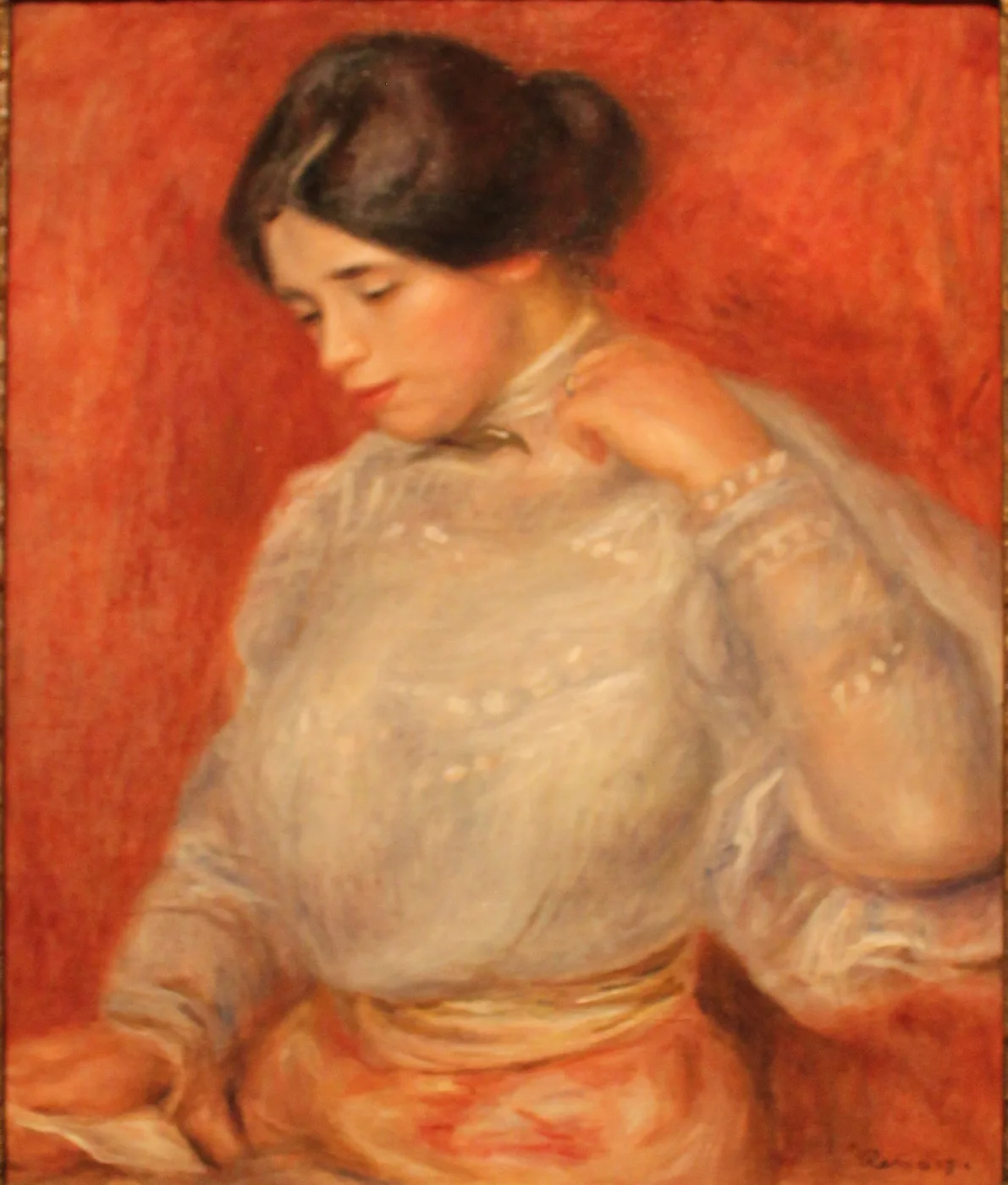
The Hermitage portrait shows Samary at close range, her fair, reddish hair and pale skin set against a loosely brushed interior, rendered with the soft, flickering touch typical of Renoir’s work in this decade. Her expression is animated rather than composed for formality, closer to a glance caught mid-conversation than a posed sitting.
Renoir’s palette favours warm pinks and creams in the skin, set against cooler, more muted tones in the background, so Samary’s face and colouring hold the eye immediately. The brushwork throughout is loose and broken, built from small overlapping strokes rather than smooth blending, a hallmark of Impressionist portraiture at its most confident.
Little in the picture insists on Samary’s celebrity. There is no obvious theatrical costume or stage setting; instead, Renoir paints a young woman he knew and admired, letting her personality carry the picture rather than any external symbol of her profession.
That restraint is part of what makes the portrait feel intimate rather than ceremonial. It sits closer in spirit to paintings Renoir made of his own family and friends than to the grander commissioned portraits he sometimes produced for wealthier patrons.
From Paris to St Petersburg
The painting’s presence today in the Hermitage Museum places it among one of the world’s great encyclopaedic collections, alongside works by many of Renoir’s Impressionist contemporaries acquired by Russian collectors in the decades around 1900. Russian collectors were, in fact, among the earliest and most enthusiastic buyers of French Impressionist painting outside France itself.
Seen today, the portrait offers a rare, unguarded glimpse of a performer whose stage career survives mostly in written accounts rather than any moving record of her on stage. Renoir’s brush preserves something written descriptions cannot: the particular colour of her skin under a particular light, and an expression that seems to belong to a specific, fleeting moment rather than a formal pose.
On a wall, the portrait’s warmth changes gently with the light in a room. Samary’s pale skin and reddish hair glow more under warm lamplight and settle into cooler, quieter tones by day, so the sense of a captured, passing moment never quite fixes into something static.
Sizes and materials for Portrait of Jeanna Samary are listed on its product page.