A Nymph by a Stream
A Study in the Shadow of Courbet
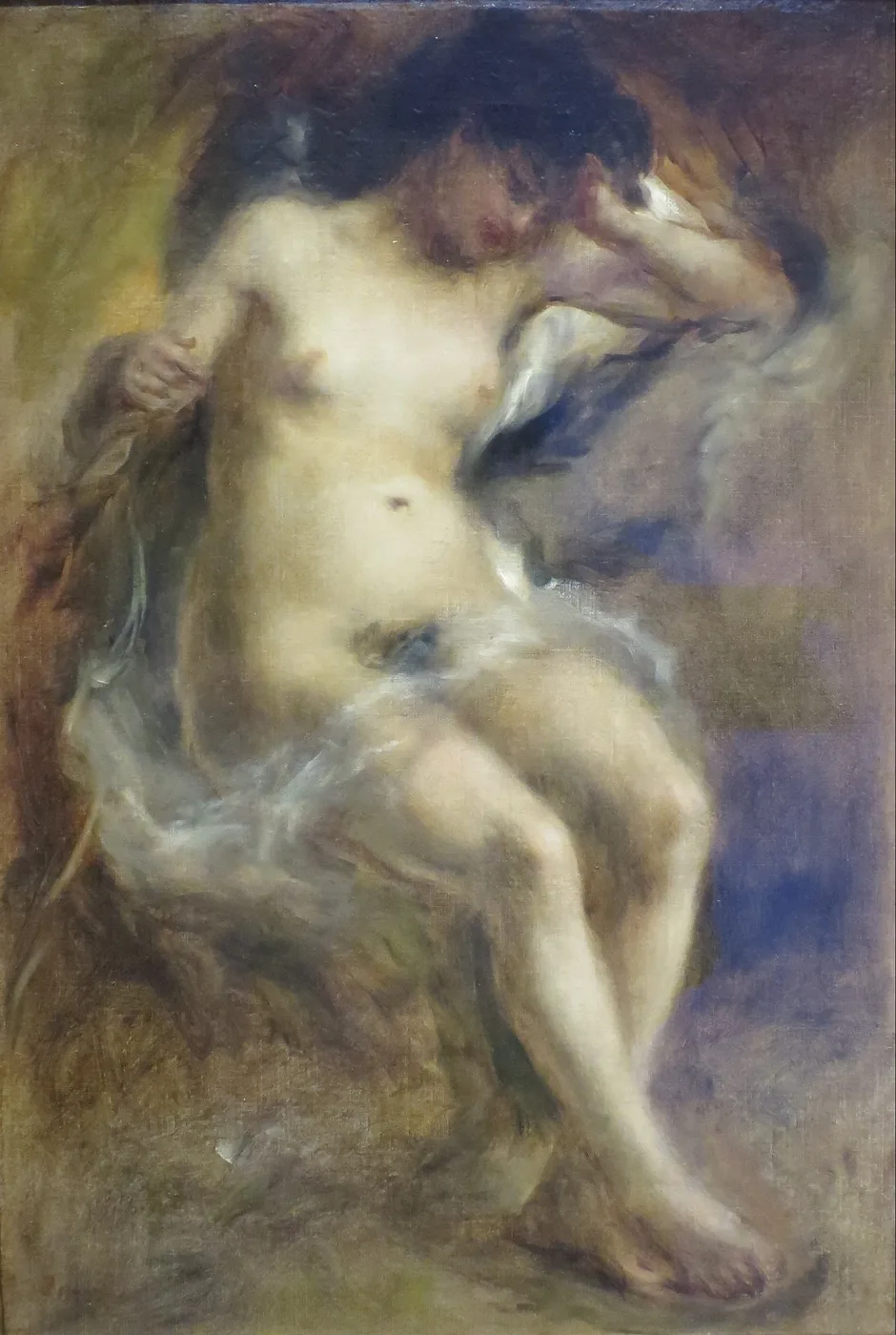
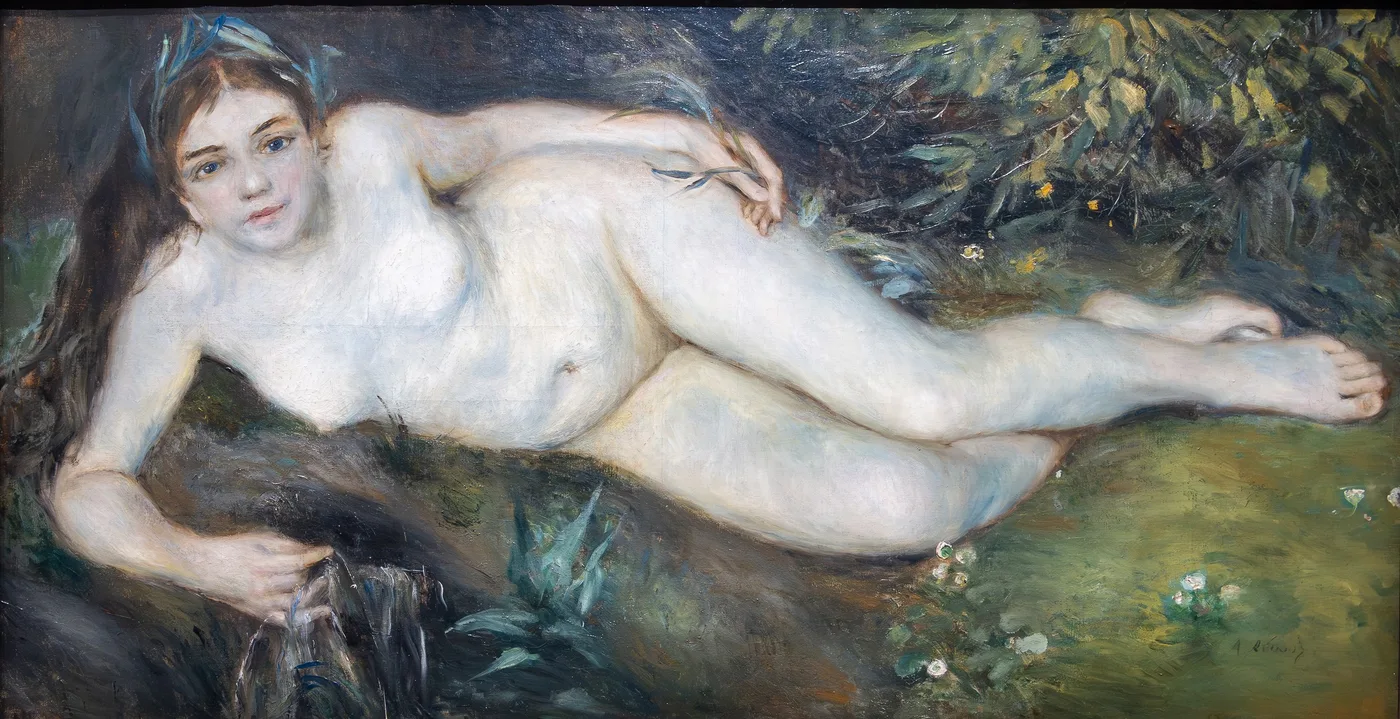
Before Renoir became known for sunlit gardens and rosy-cheeked children, he was a young painter working through the example of Gustave Courbet. A Nymph by a Stream belongs to this formative period, when he was testing how far realism could carry a nude figure. The painting shows a woman reclining beside a woodland stream, her body turned toward the viewer while she seems unaware of being watched.
Courbet’s influence is unmistakable in the handling of flesh. Renoir builds the body with thick, confident strokes rather than the feathery touches that would later define his Impressionist work. The paint sits heavily on the canvas, giving the figure a physical weight that anchors the whole composition.
This was a period when Renoir, like many young painters in Paris, needed to prove he could handle the human figure with the seriousness that the Salon jury expected. Realist painting, with its unidealised bodies and dark tonal ranges, offered a route to recognition that owed less to fantasy than to observation.
Flesh, Water and the Weight of Paint
The stream itself is rendered in murky greens and browns, more a backdrop than a subject in its own right. Light falls unevenly across the scene, catching the woman’s skin while leaving the surrounding foliage in shadow.
There is little of the dappled, broken colour that Renoir would later use to describe outdoor light. Instead the paint is laid on in broad, continuous passages, closer in spirit to the tonal painting of the Barbizon generation than to Impressionism.
The nymph’s pose recalls a long tradition of reclining female figures in European painting, stretching back through Titian and Giorgione. Renoir was working within that inherited vocabulary even as he pushed toward a rougher, more tactile description of the body.
A Small Canvas With Outsized Ambition
Physically the painting is modest in scale, closer to a study than a grand Salon machine. Yet within that small format Renoir set himself a demanding task: to make a single nude figure carry the whole weight of the composition.
The background is kept deliberately simple, with none of the incidental detail that might distract from the body itself. This concentration on the figure, stripped of narrative context, points toward the economy of means Renoir would keep even after his style changed.
Brushwork in the hair and drapery is looser than in the flesh, suggesting Renoir moved through the canvas at different speeds, tightening his touch where the anatomy needed precision and loosening it where texture alone would do.
Renoir Before Impressionism
A Nymph by a Stream is now held at the National Gallery in London, where it sits among the museum’s wider holdings of nineteenth-century French painting. Seen alongside Renoir’s later, brighter canvases, it reads almost as the work of a different painter.
That contrast is exactly what makes it valuable to look at closely. It shows a Renoir still finding his footing, absorbing lessons from Courbet’s realism before he found the looser, sun-struck manner for which he is now best known.
The dark palette and dense paint surface have none of the pastel lightness of his 1870s work. What they share with it, though, is an evident pleasure in describing skin, in finding the small variations of tone that make a painted body feel alive.
On a wall, this is a picture that rewards close looking rather than a passing glance. Its dim tonality means it changes considerably depending on the light in the room, the shadows in the stream bank deepening or lifting as the day moves.
In low light the figure can seem to emerge slowly out of the surrounding darkness, an effect that would have been familiar to viewers of Courbet’s own work. In brighter light, the modelling of the body becomes more legible, the transitions between light and shadow across the skin easier to trace.
It is not a painting built for spectacle. It asks for patience, and repays it with the sense of watching a major painter still working out, stroke by stroke, what kind of painter he wanted to be.
For a visitor encountering Renoir’s name for the first time through this canvas, it is worth remembering that the artist most associated with warmth and light began here, in the shadowed, earthbound realism of a stream bank and a single reclining figure.
Sizes and materials for A Nymph by a Stream are listed on its product page.