By the Seashore
A Late Summer on Guernsey
In September 1883 Renoir travelled to Guernsey, in the Channel Islands, and spent several weeks painting its coves, cliffs and bathers. The trip gave him a break from Paris and a new stretch of coastline to explore.
He arrived at something of a turning point in his career. He had recently returned from Italy, where the clarity of Raphael’s frescoes had left him doubting the loose, flickering technique of his earlier Impressionist years.
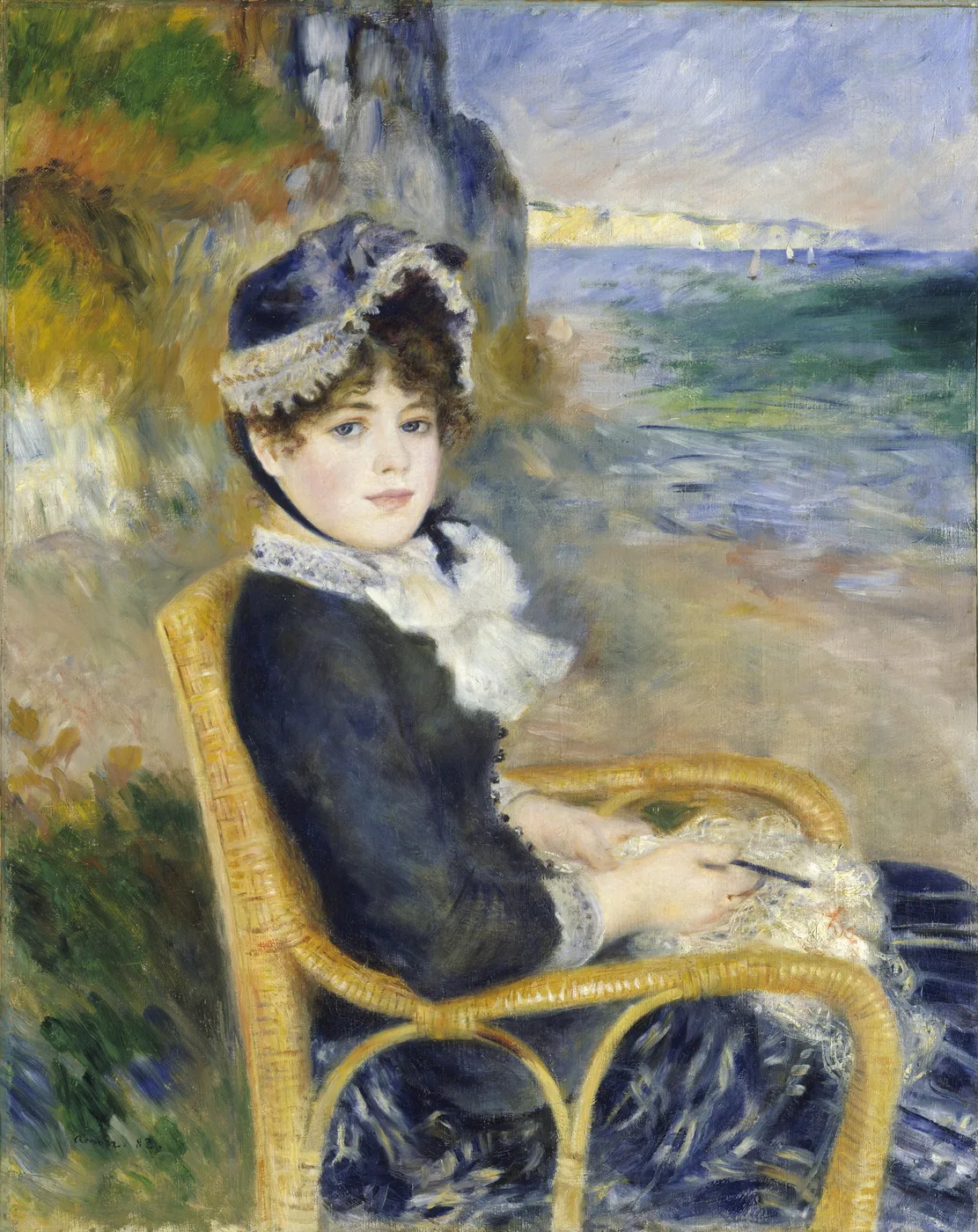
By the Seashore was painted during this Guernsey stay. It shows a single young woman seated near the water, her hat and blouse rendered with more precision than Renoir’s figures from a decade before.
The trip produced several related seaside pictures, painted quickly outdoors in changeable island weather. This one concentrates on a single sitter rather than the beach crowds he studied in other canvases from the same weeks.
A Single Figure Against Sea and Sky
The woman sits close to the picture plane, seen from the waist up, her body turned slightly to one side while her gaze meets the viewer directly. Nothing else competes for attention around her.
She wears a straw hat trimmed with a blue ribbon that echoes the blue of the sea stretching out behind her, and a pale blouse gathered at the shoulders. The colours of hat and sea answer one another across the canvas.
Her hands rest quietly in her lap. There is no anecdote here, no story being told; she exists simply as a figure enjoying the sea air on a bright afternoon.
A Firmer Hand: Renoir’s Changing Style
Compared with Renoir’s paintings from the mid-1870s, the drawing here is noticeably tighter. The contours of the face, hat and shoulders are more clearly stated, the modelling more solid.
This shift reflects what Renoir himself later described as a kind of crisis in his work, a feeling that pure Impressionism had taken him as far as it could go. He wanted to recover some of the structure he associated with older art.
By the Seashore sits right at the start of this change. The background sea and sky are still handled loosely, in broad, breezy strokes, while the figure herself is built with far greater care.
The contrast between the two kinds of handling, precise on the figure and loose behind her, is one of the picture’s most telling features. It shows Renoir working out a new balance in real time, rather than arriving at it fully formed.
Some of Renoir’s closest colleagues found this new direction puzzling, more accustomed to the loose, sunlit technique he had spent the previous decade perfecting. Renoir persisted regardless, convinced that his earlier method had reached its limits.
Colour Pared Back to Essentials
The palette is unusually restrained for Renoir: blues and greys for the sea, warm flesh tones for the face and hands, and touches of white and cream in the blouse and hat. Little else intrudes on this narrow range.
Small strokes of pink appear in the cheeks and along the ribbon, quiet notes of warmth against the coolness of the surrounding sea and sky. They keep the portrait from feeling cold despite its restrained range.
The simplicity of this colour scheme lets the contrast between the finished figure and the sketch-like background carry the whole composition. Little else is needed to hold the eye.
Living with By the Seashore
The painting is now held at the Metropolitan Museum of Art in New York, where its bright, salt-air palette stands out among Renoir’s more crowded figure paintings. It rewards viewers who come looking for his quieter, later manner.
Seen in daylight, the blues of the sea and ribbon seem to lift, while the warmer tones of the face and hat hold steady, keeping the woman anchored at the centre of the picture. The overall balance rarely feels lost, whatever the light in the room.
Alongside his more populated seaside scenes from the same Guernsey weeks, this single-figure portrait shows Renoir working at an intimate scale, testing his new technique on one sitter before returning to larger, more crowded compositions. The smaller scale suited the more deliberate pace of his new approach.
It is a quiet, self-contained image, easy to read at a glance. Yet it is built on the tension between Renoir’s old fluency with paint and the firmer discipline he was just beginning to search for.
Returned to again and again, the picture keeps giving up the same small pleasure: a single figure, a stretch of open water, and the particular light of an island afternoon in early autumn. That pleasure has not required updating with time.
Sizes and materials for By the Seashore are listed on its product page.