Le Pont Neuf
A View Rented for the Occasion
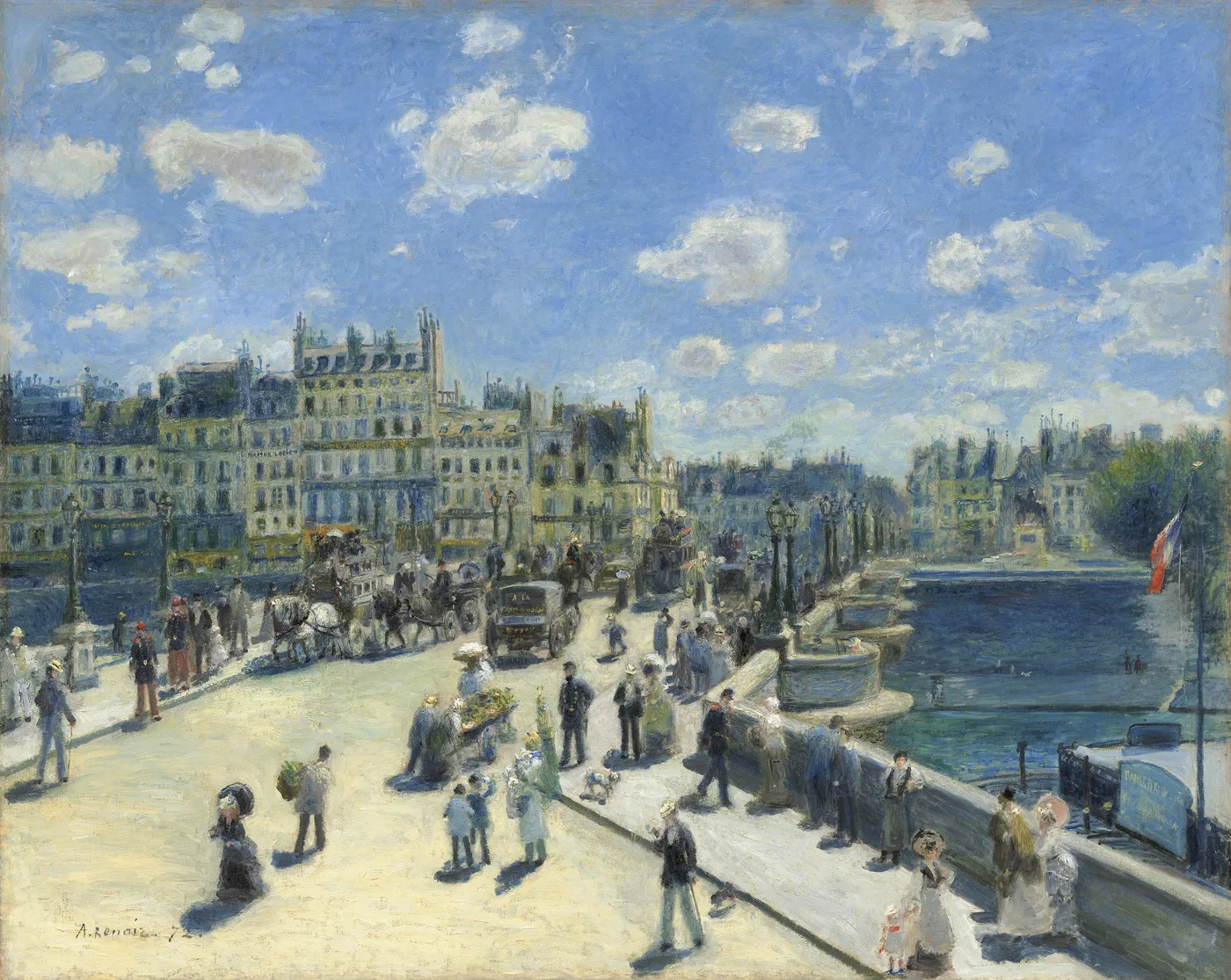
In the summer of 1872, Renoir wanted to paint the Pont Neuf, the oldest bridge across the Seine in Paris, thronged as it always was with pedestrians, carriages and street traders. To get the elevated view he needed, he rented a room on the upper floor of a building on the Quai du Louvre, looking down across the bridge and the river beyond.
This was a deliberate, practical decision rather than a chance sighting. Renoir wanted the crowded, moving life of the bridge seen from slightly above, the way a Parisian walking along the quay might glimpse it, rather than a formal, static view of the structure itself.
The result is one of the clearest early statements of what would become a central Impressionist subject: modern Paris, its streets and bridges full of anonymous people going about ordinary business, painted with the same seriousness once reserved for history or myth.
Renoir’s Brother, Sent Out to Stall the Crowd
According to an account later recorded by the dealer and writer Ambroise Vollard, Renoir enlisted his brother Edmond to help him capture the crowd accurately. Edmond would walk out onto the bridge, stop passers-by and ask them the time, holding them still just long enough for Renoir to sketch their pose from the window above before they moved on.
It is a small, practical story, but it says a great deal about how carefully Renoir was studying the specific, unposed way ordinary people stand, walk and gather in groups. He wanted figures that looked genuinely caught in motion, not artfully arranged.
That attention shows in the finished canvas, where dozens of small figures are scattered across the bridge in a wide variety of poses, none of them repeating, each rendered with just a few economical strokes.
A Bridge Filled With Ordinary Parisians
The composition is built around the strong diagonal line of the bridge itself, cutting across the canvas from the lower right toward the middle distance, crowded along its length with tiny figures in dark and pale clothing. Carriages and a few horse-drawn vehicles punctuate the crowd, adding scale and movement to the scene.
Beyond the bridge, the Seine opens out, with the buildings and towers of the Île de la Cité and the right bank rising hazily in the distance under a bright, changeable sky. Renoir gives real attention to that sky, a mix of pale blue and soft grey cloud that sets the tone for the light falling on the scene below.
The eye meets the crowded foreground of the bridge first, drawn by the density of small figures and the play of light and shadow across the paving stones, before travelling back toward the softer, more atmospheric distance.
Renoir’s handling throughout is quick and broken, particularly in the crowd itself, where individual figures are suggested through a few deft touches of colour rather than careful outline. It is a technique built for capturing movement rather than static description.
Bright Paris Light Over Stone and Water
Sunlight falls across the bridge unevenly, picking out pale stone and the tops of hats and parasols while leaving other passages in soft shadow. Renoir uses this play of light partly to organise the composition, guiding the eye along the crowded diagonal of the bridge toward the river and sky beyond.
The palette favours soft creams, greys and pale blues, warmed by touches of ochre in the stonework and occasional brighter notes of colour in the crowd’s clothing. Nothing in the picture is rendered in flat, even colour; every surface seems to be responding to the specific, slightly hazy light of a Paris afternoon.
Le Pont Neuf Today, at the National Gallery of Art
The painting is now held at the National Gallery of Art in Washington, where it stands as one of the clearest early demonstrations of the Impressionist interest in the modern city as a subject worth painting in its own right.
Seen today, its crowded bridge still reads as a genuinely observed piece of nineteenth-century Paris, full of individuals who were, for a moment, simply going about their day while a painter watched from a window above.
On a wall, it is a picture that keeps offering new detail on repeated viewing: a particular figure’s stance, a carriage half-hidden in the crowd, the exact grey of the sky. Morning light tends to flatten the pale stonework of the bridge, while softer afternoon light draws out the warmer tones scattered through the crowd, so the picture never quite settles into a single fixed mood.
Sizes and materials for The Pont Neuf are listed on its product page.