The Cup of Chocolate
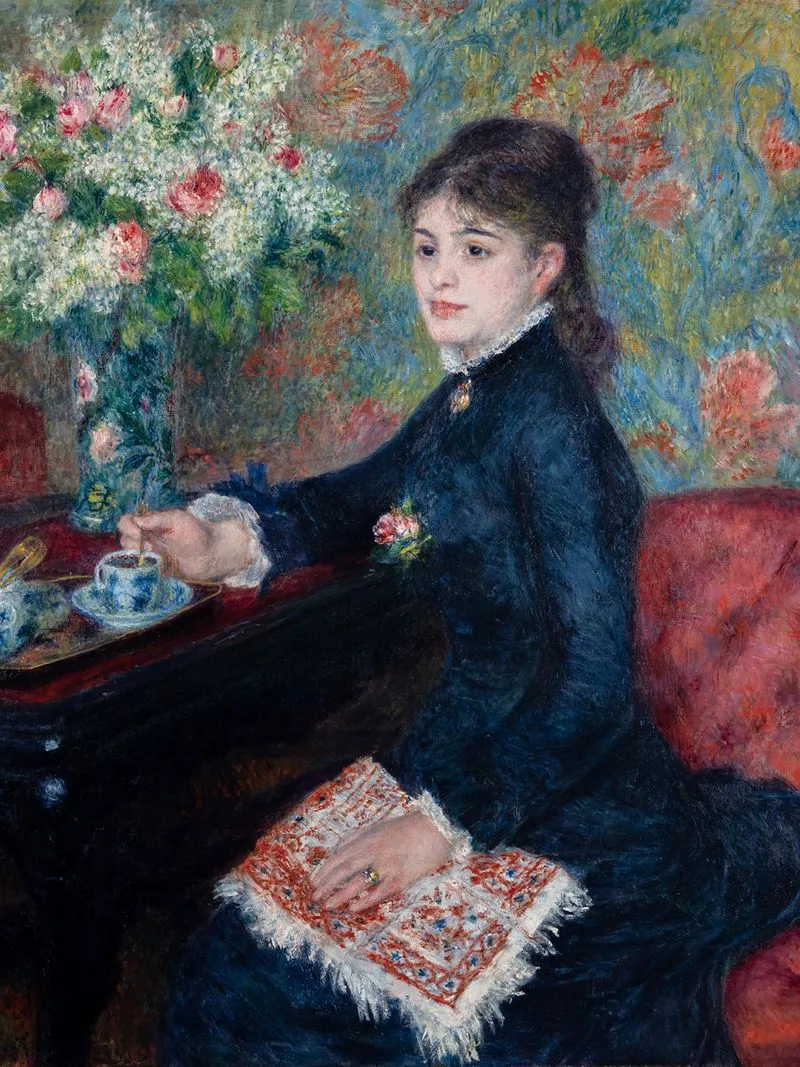
By 1877 Renoir was exhibiting with the Impressionists for the third time. He was beginning to attract a small but useful circle of patrons in Paris, among them the publisher Georges Charpentier and his wife Marguerite, whose salon brought him into contact with writers, actresses and society women willing to sit for informal portraits.
The Cup of Chocolate belongs to this world of intimate indoor subjects. It was painted as Renoir moved away from outdoor Impressionist landscape toward figure painting set in domestic interiors.
Hot chocolate, like tea, was a fashionable drink among the Parisian bourgeoisie, taken in the late morning or afternoon in private rooms rather than in public cafés. A painting built around this small ritual gave Renoir a subject that was modern, feminine and entirely without incident, which suited his growing interest in mood and colour over narrative.
A Quiet Ritual in a Paris Interior
The picture shows a young woman seated at close range, absorbed in the cup she holds rather than looking out at the viewer. Her pose is informal, the kind of unguarded moment Renoir favoured over the stiffer conventions of commissioned portraiture, and the setting is kept simple so that nothing competes with her face, hands and the porcelain she holds.
She wears a fitted, high-necked dress typical of the period’s daytime fashion, its darker tone offsetting the pale porcelain and her lightly flushed skin. Little jewellery or ornament is visible; Renoir keeps the emphasis on the exchange between her face and the cup rather than on costume detail.
Warm flesh tones dominate the canvas, set against softer, more muted background colour that gives no specific detail of the room. Renoir was less concerned with describing furniture or wallpaper than with the fall of light across skin and fabric, a preference that runs through nearly all his figure paintings of this decade.
Renoir’s Women of the Late 1870s
Portraits and genre scenes of young women engaged in small domestic acts, reading, sewing, taking tea or chocolate, became one of Renoir’s most consistent subjects through the second half of the 1870s. They allowed him to paint the human figure with the same freedom of brushwork he applied to landscape, while offering patrons pictures that were pleasant to live with rather than challenging.
These works were also more saleable than his outdoor Impressionist scenes, which still met resistance from critics and buyers accustomed to more finished Salon painting. A cup of chocolate, held gently in a woman’s hands, was an unthreatening subject that let Renoir experiment with colour and touch without provoking the hostility his landscapes sometimes attracted.
Warmth Held in a Porcelain Cup
The cup and saucer themselves are painted with quick, economical strokes, white touched with blue and violet shadow rather than rendered in exact detail. This loose handling extends to the woman’s hands, which are suggested through a few decisive marks rather than tightly drawn, keeping the whole image soft and slightly unfinished at the edges.
Renoir’s brush moves fastest and loosest at the margins of the composition and grows more attentive around the face, where the eye naturally settles. This uneven finish, sharper in some passages, freer in others, is characteristic of his working method in the 1870s and gives his portraits a sense of immediacy rather than careful posed stillness.
Colour throughout leans toward warm pinks, creams and soft browns, occasionally broken by a cooler note in the shadows or in the china. The overall effect is intimate rather than grand, a small, quietly lit scene rather than a public statement.
A Painting’s Journey to the Gulf
The Cup of Chocolate is now held at the Louvre Abu Dhabi, where it sits among a collection that deliberately places French Impressionist painting alongside work from many other periods and cultures. Seeing a small, intimate Renoir portrait in that setting is a reminder of how far paintings made for private Parisian collectors in the 1870s have since travelled.
The museum’s approach, arranging art by theme and chronology across civilisations rather than by national school, gives this modest domestic scene a different kind of company than it would have kept in a purely European survey of Impressionism. A visitor moving through its galleries might encounter Renoir’s small portrait not among rows of French pictures but beside objects from entirely different traditions and centuries.
A Small Domestic Moment, Kept Alive
On a wall, the painting asks to be looked at from close range rather than across a room, since much of its interest lies in the small variations of touch around the cup and the sitter’s hands. Its warm palette keeps it comfortable in most kinds of light, gentle in the morning and richer under lamplight in the evening.
There is nothing dramatic in the scene, no story beyond a woman pausing over a warm drink, and that restraint is exactly the point. Renoir trusted that colour and brushwork alone could hold a viewer’s attention, without any incident to explain why the moment mattered.
Sizes and materials for The Cup of Chocolate are listed on its product page.