Portrait of Adèle Besson
A Sitter in Renoir’s Last Years at Cagnes
By 1918 Renoir was seventy-seven and had been living for over a decade at Les Collettes, his house among the olive groves above Cagnes-sur-Mer on the French Riviera. Rheumatoid arthritis had by then twisted and stiffened his hands so severely that he worked with a brush wedged between his fingers, his arm supported by an assistant when the pain grew too great to lift it unaided.
He painted almost daily even so, working through the last year of the First World War in a household marked by loss: his sons Jean and Pierre had both been wounded in the fighting, and his wife Aline had died in 1915. Portraiture from these years tends toward friends, family, and local sitters willing to pose for a painter whose sessions could no longer be long or physically demanding.
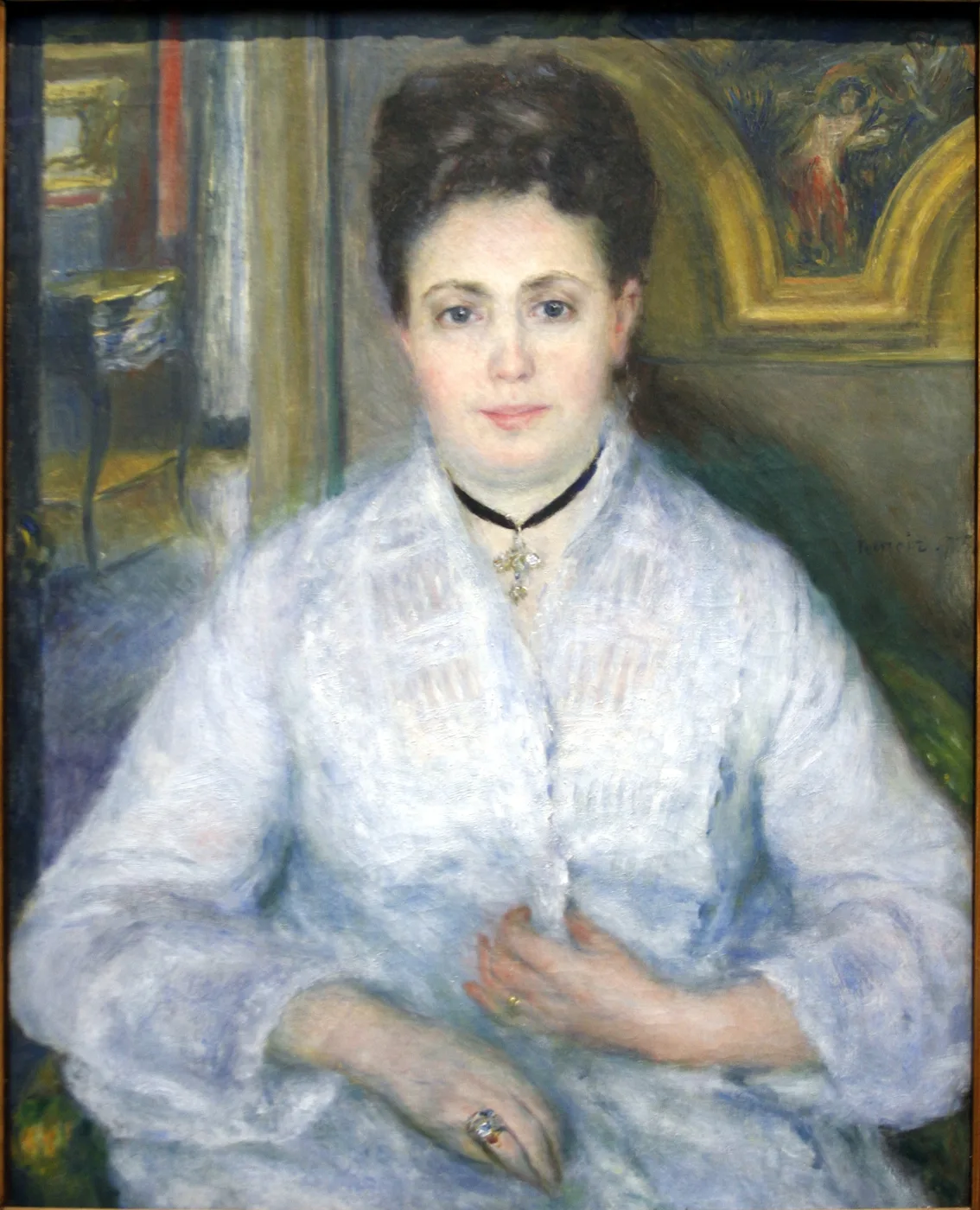
Adèle Besson was one such sitter, the wife of a friend from the region who visited Renoir at Les Collettes. Little documented biography survives about her beyond her connection to the household, but the portrait itself records a specific, present woman rather than an anonymous model.
A Face Built from Warmth
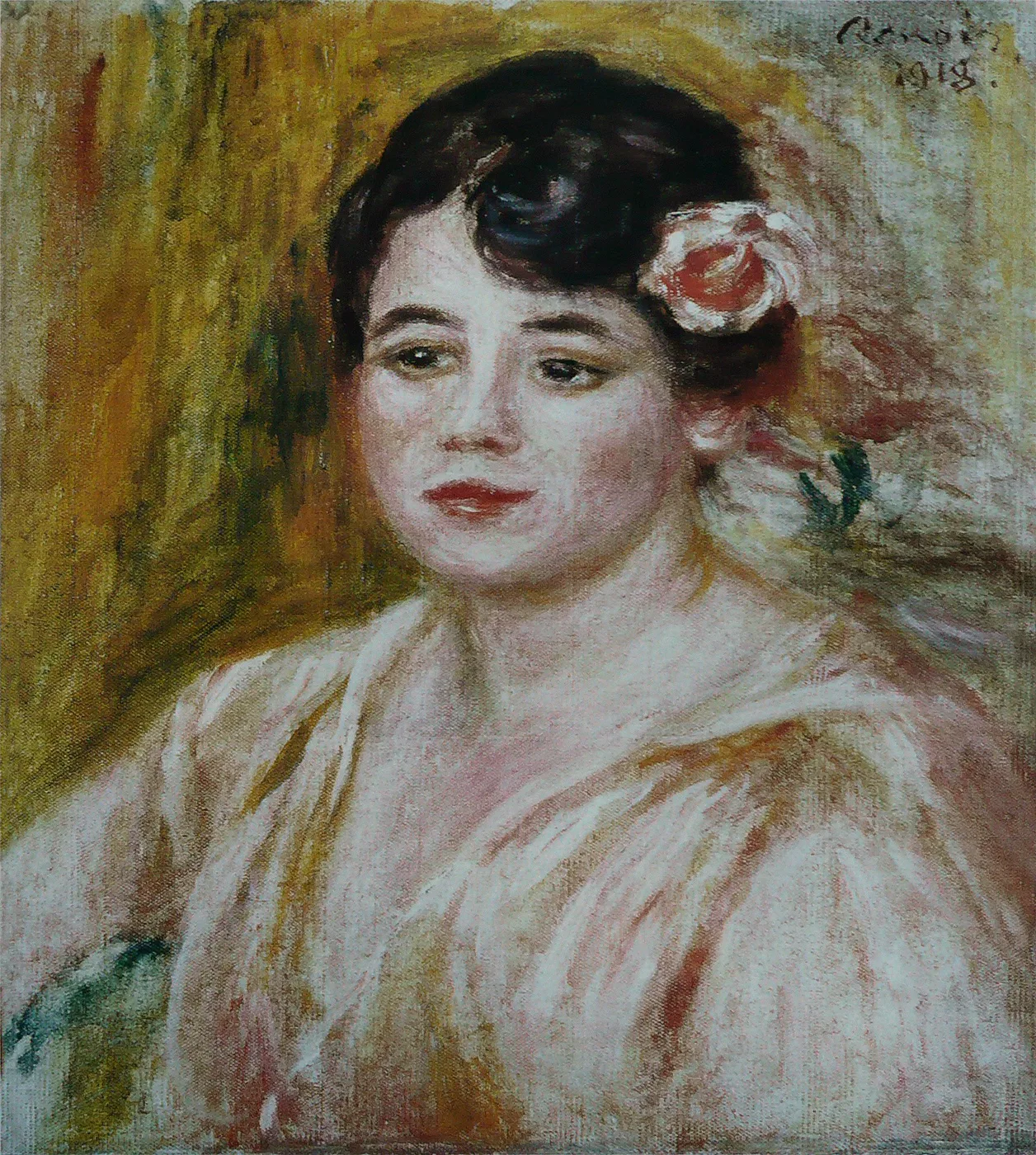
The portrait shows Adèle Besson from the chest up, her head turned slightly, her gaze meeting the viewer with an even, unguarded directness. There is little in the way of elaborate setting; the background dissolves into loose, warm colour rather than any legible room or landscape.
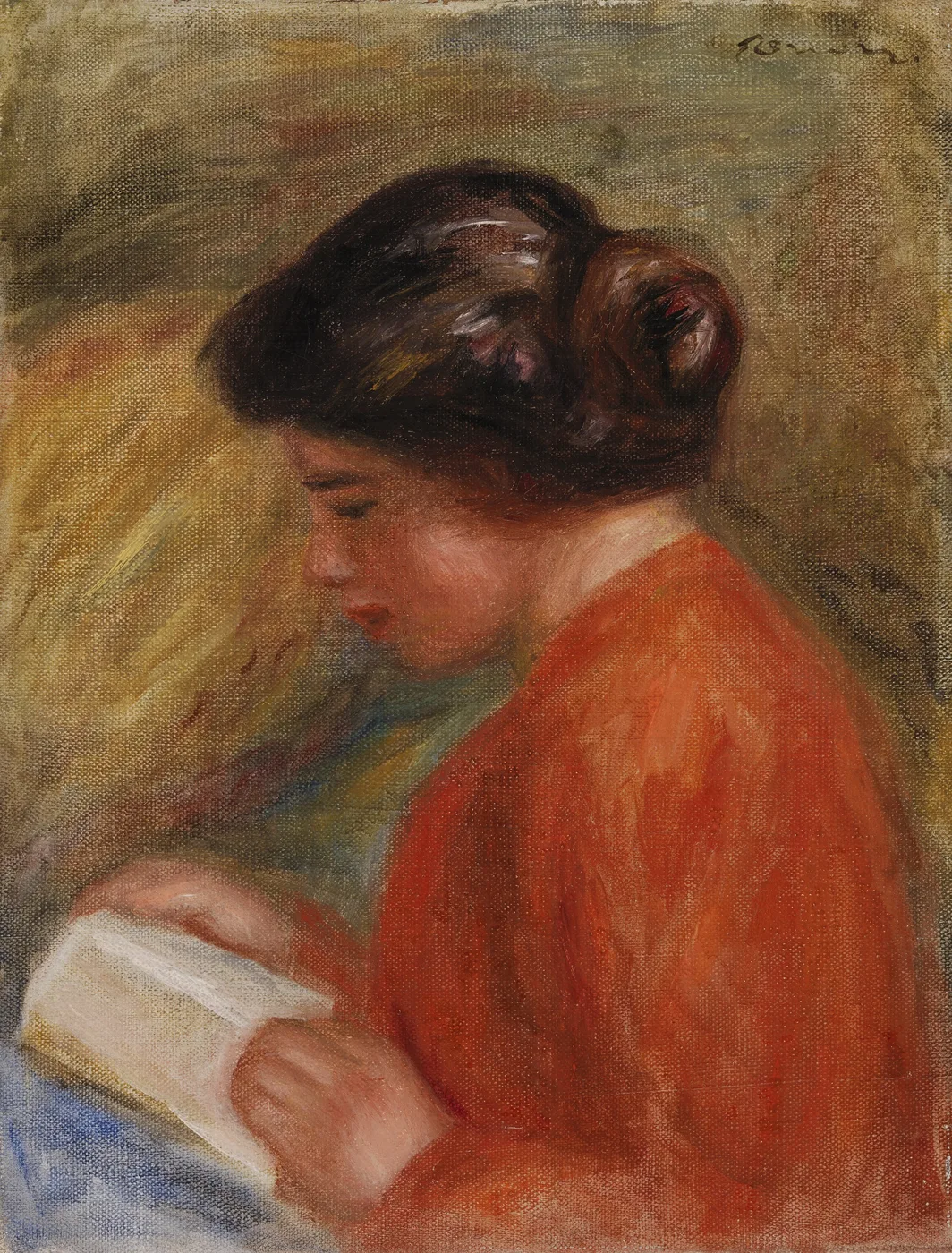
Her face is built from close-toned pinks, reds, and creams, the paint laid on in broad, confident strokes that blur the line between cheek and shadow rather than drawing it. Renoir gives almost no hard edge anywhere in the picture, so that hair, skin, and clothing all seem to grow out of the same warm haze of colour.
Her hair and dress are suggested rather than described in detail, dark passages set against the flushed tones of her face, enough to place the figure firmly in the frame without competing for attention with the head, which remains the clear centre of the composition.
Painting Through Pain
The brushwork in this late portrait is unmistakably that of an artist working within severe physical limits, yet it does not read as diminished. The strokes are broader and less exact than in Renoir’s work of the 1870s and 1880s, but they carry a fluency that suggests decades of accumulated control finding a new, looser register.
Colour, rather than line, does almost all the work of describing form. Renoir models the structure of a cheek or a jaw through shifts in the warmth and density of red and pink rather than through drawn contour, a method that had been developing in his work since around the turn of the century and reached one of its fullest expressions in these final years.
This late manner is often called Renoir’s final period, in which the human figure, especially the female face, is rendered almost entirely through warm, saturated colour rather than the firmer draughtsmanship of his middle years.
An Intimate, Unshowy Commission
Unlike Renoir’s earlier Salon ambitions or his large Impressionist group scenes, a portrait like this one was never meant to prove anything to a jury or a public exhibition. It belongs to the quieter category of pictures painted for friends and acquaintances near the end of his life, made as much for the pleasure of the sitting as for any grander purpose.
That informality shows in the picture’s directness. There is no elaborate costume, no symbolic prop, no constructed narrative, only a woman’s face observed closely and rendered with evident warmth toward the sitter.
Renoir painted several such friends and neighbours during his last years at Cagnes, sitters drawn from the small circle of people who continued to visit an ageing, largely immobile painter. Each of these late portraits shares the same unhurried, close attention, as though the act of looking closely at a familiar face had become one of the few physical pleasures still fully open to him.
Now in Besançon
The portrait belongs to the Musée des Beaux-Arts et d’Archéologie de Besançon, one of France’s older municipal museums, where it sits among a broader collection spanning several centuries of French and European painting.
Seen in the museum today, the painting still carries the immediacy of a sitting conducted at close quarters, the warmth of its colour giving the impression of a face lit by late afternoon sun rather than a studio lamp.
It is a small, unforced picture, the kind that rewards a slow look rather than a dramatic first impression, its soft red and pink tones shifting gently as the light in the room around it changes through the day.
Sizes and materials for Portrait of Adèle Besson are listed on its product page.